

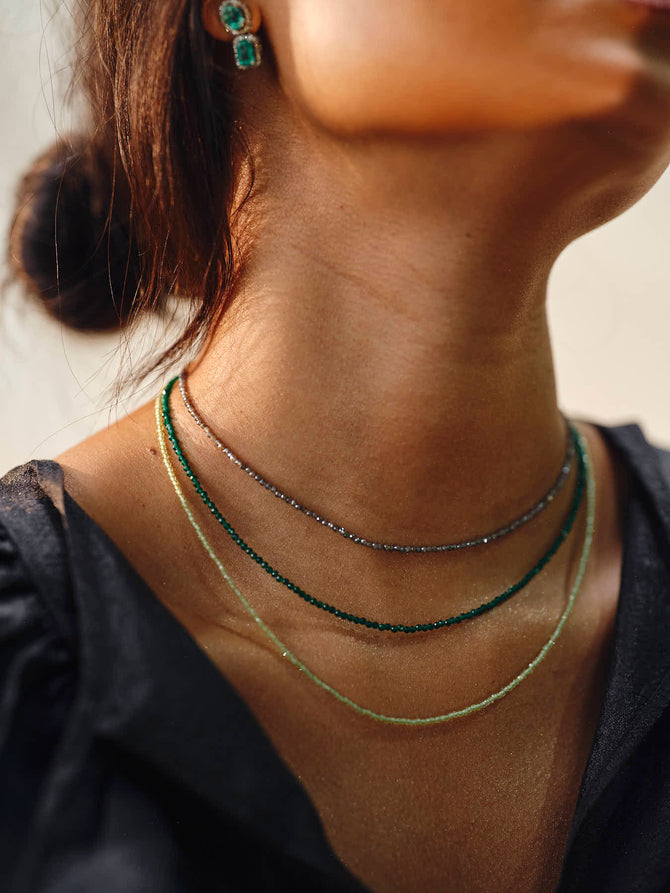
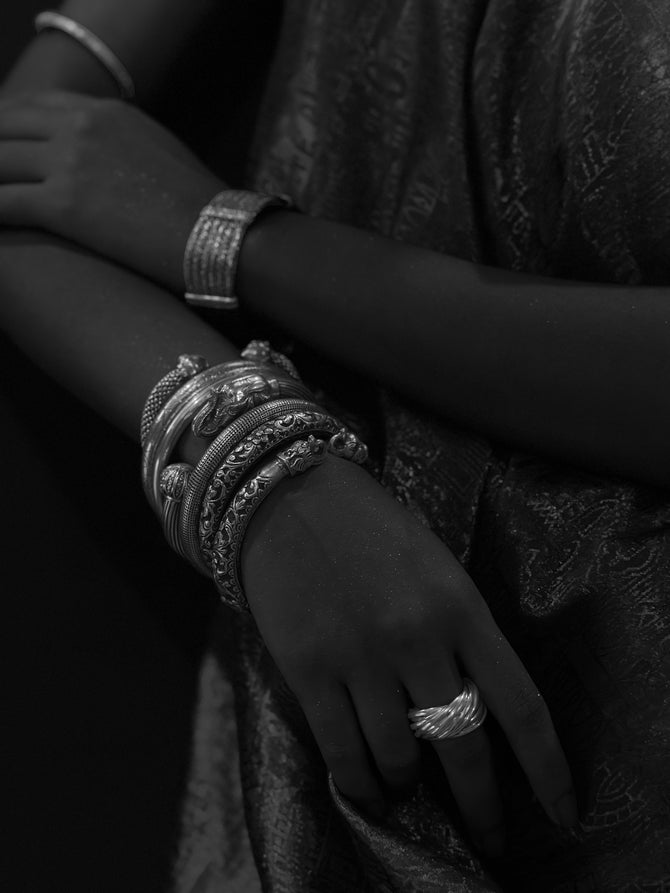
Navratna jewellery is a classical Indian jewellery tradition featuring nine specific gemstones, each representing one of the nine celestial bodies (Navagrahas) in Vedic astrology. The word itself means exactly that: nava (nine) + ratna (gems). Worn for centuries by Indian royalty, the Navratna has always been considered deeply auspicious — a piece that doesn't just adorn, but protects and aligns.
Today, the tradition is being reinterpreted by a new generation of designers — including us at Pataaka — who believe ancient craft belongs in a modern wardrobe.
The nine stones and what they represent
Each stone in a Navratna corresponds to a specific planet (graha), and by extension, a set of qualities that stone is believed to channel. Here's the full lineup:
1. Ruby (Manik) — the Sun The anchor of the Navratna. Ruby represents vitality, confidence, and leadership. Traditionally placed at the centre of a Navratna piece, it's the star the other stones orbit. Deep red, commanding, impossible to ignore.
2. Pearl (Moti) — the Moon The emotional counterpart to the ruby's fire. Pearl is associated with calm, intuition, and mental clarity. Natural pearls have a luminous quality that no synthetic stone replicates — they literally glow from within, the way moonlight does.
3. Red Coral (Moonga) — Mars Mars brings energy, courage, and drive — and red coral reflects that perfectly. It's one of the more unusual Navratna stones: technically organic (formed by marine polyps), not mined from the earth.
4. Emerald (Panna) — Mercury Mercury rules communication, intelligence, and creativity. Emerald's deep green has long been associated with growth and articulation. It's also one of the four classical "precious" gemstones, alongside ruby, sapphire, and diamond.
5. Yellow Sapphire (Pukhraj) — Jupiter Jupiter is the planet of wisdom, prosperity, and good fortune. Yellow sapphire — warm, golden, luminous — embodies that optimism. It's among the most prized stones in Indian astrological tradition.
6. Diamond (Heera) — Venus Venus governs beauty, luxury, and love — and diamond, with its unmatched brilliance, is the natural choice. In traditional Navratna settings, a diamond might be small but its placement is always deliberate.
7. Blue Sapphire (Neelam) — Saturn Saturn is discipline, karma, and structure. Blue sapphire is considered one of the most powerful — and fast-acting — stones in Vedic astrology. It's treated with respect: traditionally, one is advised to "test" a blue sapphire before committing to wearing it, as its effects are said to be felt quickly.
8. Hessonite Garnet (Gomed) — Rahu Rahu is the north node of the moon — associated with ambition, obsession, and material desire. Hessonite, a honey-coloured variety of garnet, is its stone: warm and intense, grounding Rahu's restless energy.
9. Cat's Eye Chrysoberyl (Lehsunia) — Ketu Ketu is the south node — Rahu's counterpart, associated with spirituality, detachment, and past lives. Cat's Eye is named for its distinctive optical effect: a streak of light that moves across the stone like a feline pupil. It's one of the most distinctive stones in any jewellery tradition.
The traditional arrangement
In classical Navratna jewellery, the arrangement of stones follows a specific pattern: ruby at the centre, surrounded by the other eight in a fixed sequence. The positioning matters — each stone's energy is said to be directed by where it sits relative to the others.
Traditional pieces were typically set in gold, which was believed to amplify the stones' properties. The settings were elaborate — often meenakari (enamel work) on the reverse, kundan or polki setting on the face, every surface a canvas for craft.
How Navratna jewellery is being reinterpreted today
Here's what's interesting about the Navratna in 2026: the tradition is finding a new audience. A generation that wants pieces with meaning — not just aesthetics — is discovering that a jewellery concept with thousands of years of history has considerably more depth than anything trend-driven.
Contemporary designers are working with the Navratna's spirit rather than its strict formula. That might mean nine natural gemstones arranged with the same intention but in an updated silhouette. It might mean replacing some traditional stones with accessible alternatives that carry the same colour story. It might mean a Navratna bracelet instead of a pendant, designed to be worn daily rather than locked in a vault.
Our Navratna Art Deco Bracelet at Pataaka is exactly this kind of reinterpretation. It takes the nine-stone tradition and places it in an Art Deco frame — geometric, clean, structured — because we believe ancient craft and modern design aren't opposites. They're a conversation.
Navratna as a gift
The Navratna has always been a considered gift. In Indian tradition, it's given for significant occasions — weddings, milestone birthdays, achievements — because of its layered meaning. A piece with nine stones from nine celestial bodies is a way of saying: I wish you everything.
That weight of meaning doesn't require a six-figure price tag. What it requires is intentionality — choosing a piece where the stones are real, the craft is genuine, and the tradition is honoured even as the design moves forward.
A note on astrological claims
We believe in the cultural and artistic richness of the Navratna tradition — the craft, the history, the beauty of nine natural stones brought together with intention. We're jewellers, not astrologers, so we won't make claims about gemstones curing ailments or guaranteeing fortune. What we will say is that wearing something with this much history and meaning tends to make people feel something. And that's not nothing.
CHECK OUT : Pataaka's Navratna Art Deco Bracelet is set in 925 sterling silver with natural gemstones, designed to bring one of India's oldest jewellery traditions into a contemporary wardrobe.


