

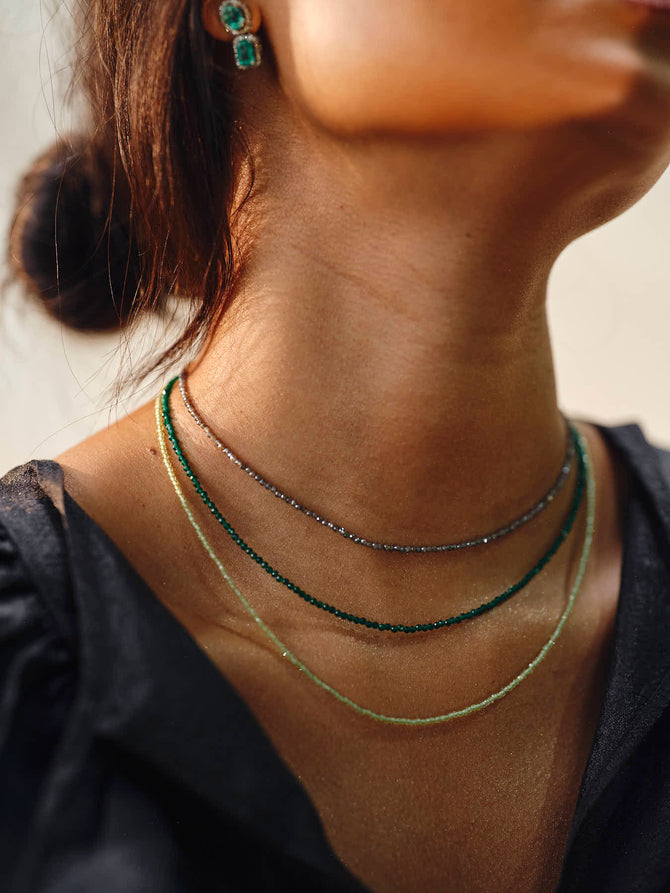
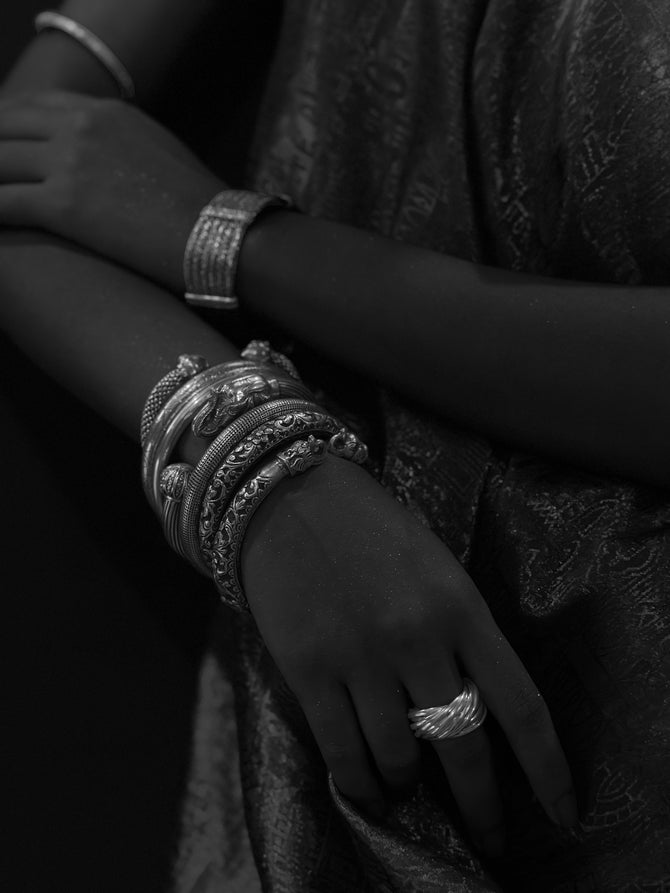
There is a assumption in fashion that looking forward means leaving the past behind. The most interesting designers working in jewellery right now are proving the opposite. The references that keep surfacing in the work that feels most alive and most original are not new at all. They are ancient. And they are being used not as nostalgia but as material — the way a writer uses history not to repeat it but to say something new with it.
What ancient traditions actually offer
Ancient jewellery traditions solved problems that modern design is still grappling with. How do you create maximum visual impact with minimal material? How do you make something by hand that is also structurally sound enough to last centuries? How do you embed meaning into an object without it becoming didactic?
Civilisations that did not have access to industrial manufacturing developed techniques of extraordinary sophistication. Granulation — the Etruscan technique of fusing tiny beads of gold onto a surface without solder — produces a texture that no machine has successfully replicated. Kundan setting from the Mughal courts of India involves pressing gemstones into pure gold foil in a way that creates a seamless union between metal and stone that looks unlike anything made any other way. Byzantine jewellery used geometric repetition and enamel colour with a boldness that looks completely contemporary when you see it in a museum case.
These are not decorative historical footnotes. They are unsolved design problems that keep attracting serious designers because the solutions are genuinely beautiful and genuinely hard to improve on.
Why it matters now specifically
We are living through a moment where the appetite for things that are handmade specific and irreproducible has never been higher. Mass production has made everything available and in doing so has made almost everything feel the same. Ancient craft traditions represent the opposite of that — techniques that require human hands human time and human skill that cannot be automated away.
When a contemporary designer draws on these traditions they are not being nostalgic. They are making a statement about what they believe jewellery is for. They are choosing difficulty over convenience and meaning over volume.
What this looks like in practice
It looks like a designer who studies Rajasthani temple jewellery not to copy it but to understand how it uses scale and layering and then applies that understanding to something that looks entirely modern. It looks like a brand that takes the Art Deco obsession with geometric precision and runs it through the lens of Indian craft traditions to produce something that could not have come from either tradition alone. It looks like work that has a specific point of view — a history behind it that you can feel even if you cannot name it.
The most forward-thinking jewellery being made today knows exactly where it came from. That knowledge is not a limitation. It is what gives the work its depth.
Connect with us on IG @pataaka_


